Report
Question Description
Write a report in 4000 words
Your task is to analyse daily operation of our supermarket and identify its risks at 5% level. Prepare a brief report for the following questions:
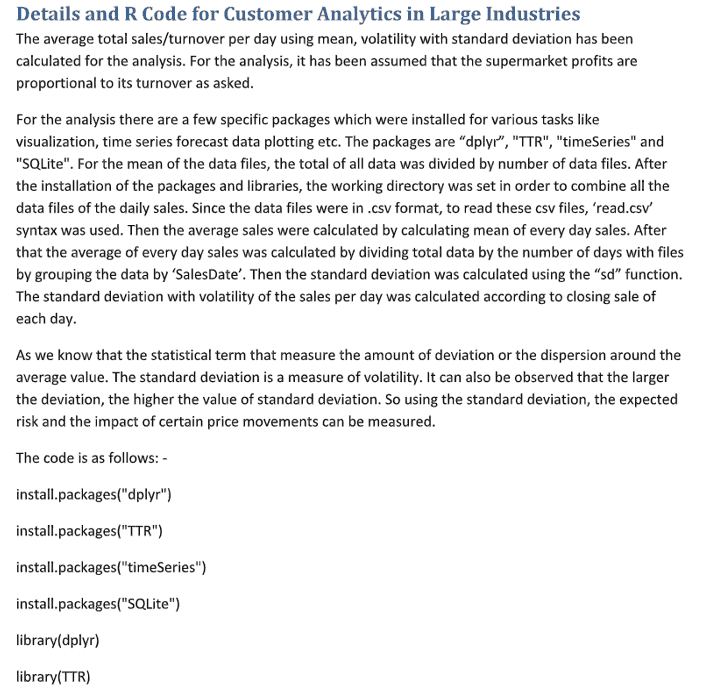
What are average total sales/turnover per day. For this report, we are interested in dollar value only. We will assume that supermarket profits are proportional to its turnover.
What is a “worst case” scenario with 5% probability. Get an estimation from the empirical (observed) data. Then fit an appropriate distribution in to sales data and estimate 5% tale for that distribution.

Exercise 2
This is your second assessable exercise which is part of the continuous assessment. This exercise is worth 10 points of your final grade.
For this exercise, you will work with the same supermarket data you used in Assignment 1. I suggest focusing on one-year data only – 2015. Mixing different years might be a bad idea as prices might change due to inflation. Customers behaviour might change over time as well. Many businesses have fixed expenditures, like rent, power bills, wages, supply cost, and somewhat random income flow that depends a number of customers/sales for any given period of time. So, even a very good organisation might become a bankrupt if it has an “unlucky” period and no savings to cover a shortfall between expenses and incomes.
Your task is to analyse daily operation of our supermarket and identify its risks at 5% level. Prepare a brief report for the following questions:

- What are average total sales/turnover per day. For this report, we are interested in dollar value only. We will assume that supermarket profits are proportional to its turnover.
- What is a “worst case” scenario with 5% probability. Get an estimation from the empirical (observed) data. Then fit an appropriate distribution in to sales data and estimate 5% tale for that distribution.
- Sales are generated by customers; hence you should try to solve the same problem through modelling customers arrivals, that is, a number of shopping trips. Estimate a model (distribution) for a number of shopping trips per day. As you don’t do analysis on the customer level, you don’t need customers ID and you don’t worry about “generic” cards. You group data by Receipt ID and date/time, to get a unique shopping trip.
- Use bootstrapping approach to model sales per day. That is, generate the number of shopping trips for Day 1 according to the estimated distribution above – X shopping trips. Then sample at random sales for X shopping trips from the empirical distribution of observed shopping trips. Summation will give you a total “possible” sales for Day 1.
- Repeat generating number of shopping trips per day and random sampling for a significant period of time, say for 10-20 years and analyse resulted distribution of total sales and in particular 5% probability worst case scenario.
- Compare and discuss results from questions 2 and 5.
- Provide one paragraph discussion on possible shortcomings of the bootstrapping procedure presented in question 4.
You have to submit one file with your report in MS Word or PDF format. Report should be brief as this is a small exercise only. While the list of questions might look intimidating, they do not require a lot of writing. But they require some graphs to show your distributions.
You don’t need to submit programming code; however, you should retain copies of all assignment computer files used during development of the solution to the assignment. These files must remain unchanged after report submission, for the purpose of checking if required. If you have any questions – feel free to ask on the forum. You can and should discuss this exercise with me and other students.